A budget phone can still play plenty of games. You just have to choose games built for modest hardware, not hope a console-style blockbuster will scale down. This guide covers games for low-end Android phones that are known to be light, and it starts by explaining what "low-end" actually means, because the label gets used loosely.
We haven't benchmarked these games on specific phones, so you won't find frame-rate numbers here. The picks are based on developer-stated requirements where they exist and on how each game is built: 2D graphics, turn-based play and small installs all help. Every game was live on Google Play in October 2026.
What "low-end" means in practice
Three things decide whether a game runs well on a phone: memory (RAM), free storage and the chipset. A low-end phone is usually short on all three.
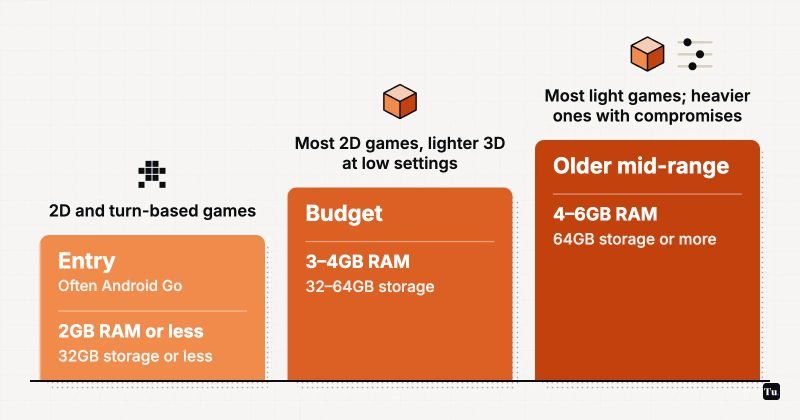
| Tier | RAM | Storage | What to expect |
|---|---|---|---|
| Entry (often Android Go) | 2GB or less | 32GB or less | 2D and turn-based games; big 3D games may not install or may crash |
| Budget | 3–4GB | 32–64GB | Most 2D games plus lighter 3D games at low settings |
| Older mid-range | 4–6GB | 64GB or more | Most of this list comfortably; heavier games with compromises |
A few details behind that table:
- Android Go edition is Google's lighter version of Android for entry-level phones. Since Android 11, Google's licensing rules have pushed new phones with 2GB of RAM or less onto Go, as reported in 2020. Google's developer documentation says any Android app can technically run on Go but warns of significant performance, network and battery limits.
- Chipsets: Low-end phones generally use entry-level processors such as Unisoc's T-series, the lower end of MediaTek's Helio range or Qualcomm's Snapdragon 4 series. Model numbers don't map neatly to performance, so treat the developer's stated minimum as the real test.
- Storage is often the hidden problem. A 32GB phone may have only a fraction of that free once the system and apps take their share, and games need room for updates.
Light games worth installing
Shattered Pixel Dungeon
Why it's light: 2D pixel art, turn-based, and nothing happens until you move. This open-source roguelike is free with optional in-app purchases and no ads label. It's one of the deepest games you can run on almost any phone.
Mindustry
Why it's light: top-down 2D graphics. Mindustry is a factory-building tower defense game with a long campaign and cross-platform multiplayer. On Google Play it's free with no ads and no in-app purchases. Very large late-game factories can push weaker phones, so build efficiently.
Free Fire (the original, not MAX)
Why it's light: Garena keeps two versions. Free Fire MAX is the higher-fidelity one. The original Free Fire is generally regarded as the better choice for phones with limited RAM, and both share the same account and 10-minute, 50-player matches. It's free with in-app purchases. If you were thinking about PUBG Mobile Lite, note that its listing hasn't been updated since January 2024.
Hill Climb Racing
Why it's light: simple 2D physics. Fingersoft lists it as fully playable offline, which also helps on phones with weak signal. It's free with ads and in-app purchases.
Geometry Dash Lite
Why it's light: flat, geometric 2D visuals. It's a rhythm platformer where you tap to jump through spike-filled levels. The Lite version is free with ads and no in-app purchases. If you enjoy it, the full Geometry Dash is a paid app with no ads.
Soul Knight
Why it's light: pixel-art shooter. It's a fast dungeon-crawling game with online co-op and offline LAN play for up to four people, plus controller support. It's free with ads and in-app purchases.
The Walking Dead: Season One
Why it's light: its listing names a 1GB RAM minimum and 2GB recommended. Telltale's choice-driven drama, now published by Skybound, is a good way to get a major story game onto a modest phone. Episode 1 is free, and episodes 2–5 are in-app purchases, either one by one or as a season pass.
Oceanhorn
Why it's light: the developer lists 1GB of RAM as the requirement. This 3D island adventure in the style of classic Zelda games is free to download. The first chapter is free, and one in-app purchase unlocks the rest, so you can check how your phone handles it before you pay. It also supports controllers.
To the Moon
Why it's light: RPG Maker-style 2D graphics, and the listing asks for at least 1GB of RAM. It's a short, emotional story game, sold as a paid app with no in-app purchases.
Chess.com and The Battle of Polytopia
Why they're light: turn-based play with simple graphics. Chess.com is free with ads and in-app purchases and includes offline games against bots. Polytopia is a free strategy game with paid tribes that its developer says works offline.
What to avoid on a budget phone
Some games publish requirements that rule out most entry-level hardware. GRID Legends needs Android 12 and at least 15GB of storage. NTE: Neverness to Everness launched with a Snapdragon 855-class chip as its minimum. Life is Strange asks for 3GB of RAM and recommends 4GB. Large free-to-play open worlds also keep growing with each update, so even a phone that runs them today may run out of space later. Our open-world guide explains which of those games are lighter.
Make any game run lighter
- Lower in-game graphics and frame rate first. These settings make the biggest difference, and turning them down also reduces heat. Our performance settings guide walks through what to change.
- Close background apps before a session. With little RAM, a browser full of tabs competes with your game for memory.
- Keep storage free. A nearly full phone slows down and can block updates. Use our storage cleanup walkthrough.
- Fix the network separately. Lag in online games is often a connection problem, not a phone problem. See how to reduce lag in mobile games.
The short version
On a budget phone, 2D and turn-based games are the safest choice, and a published low RAM requirement is a good sign. Start with Shattered Pixel Dungeon or Mindustry for depth, Hill Climb Racing for quick fun, and the original Free Fire for competitive matches. Try Oceanhorn's free chapter or The Walking Dead's free first episode before paying, so you know how your phone copes.
Sources
- Android Developers: Android (Go edition)
- 9to5Google: Google's Android RAM requirements and Android Go (2020)
- Google Play listing: Shattered Pixel Dungeon
- Google Play listing: Mindustry
- Google Play listing: Free Fire
- Pocket Gamer: What's the difference between Free Fire and Free Fire MAX?
- Google Play listing: PUBG Mobile Lite
- Google Play listing: Hill Climb Racing
- Google Play listing: Geometry Dash Lite
- Google Play listing: Soul Knight
- Google Play listing: The Walking Dead: Season One
- Google Play listing: Oceanhorn
- Google Play listing: To the Moon
- Google Play listing: Chess.com
- Google Play listing: GRID Legends: Deluxe Edition